

Healthcare That’s Fit For The Future
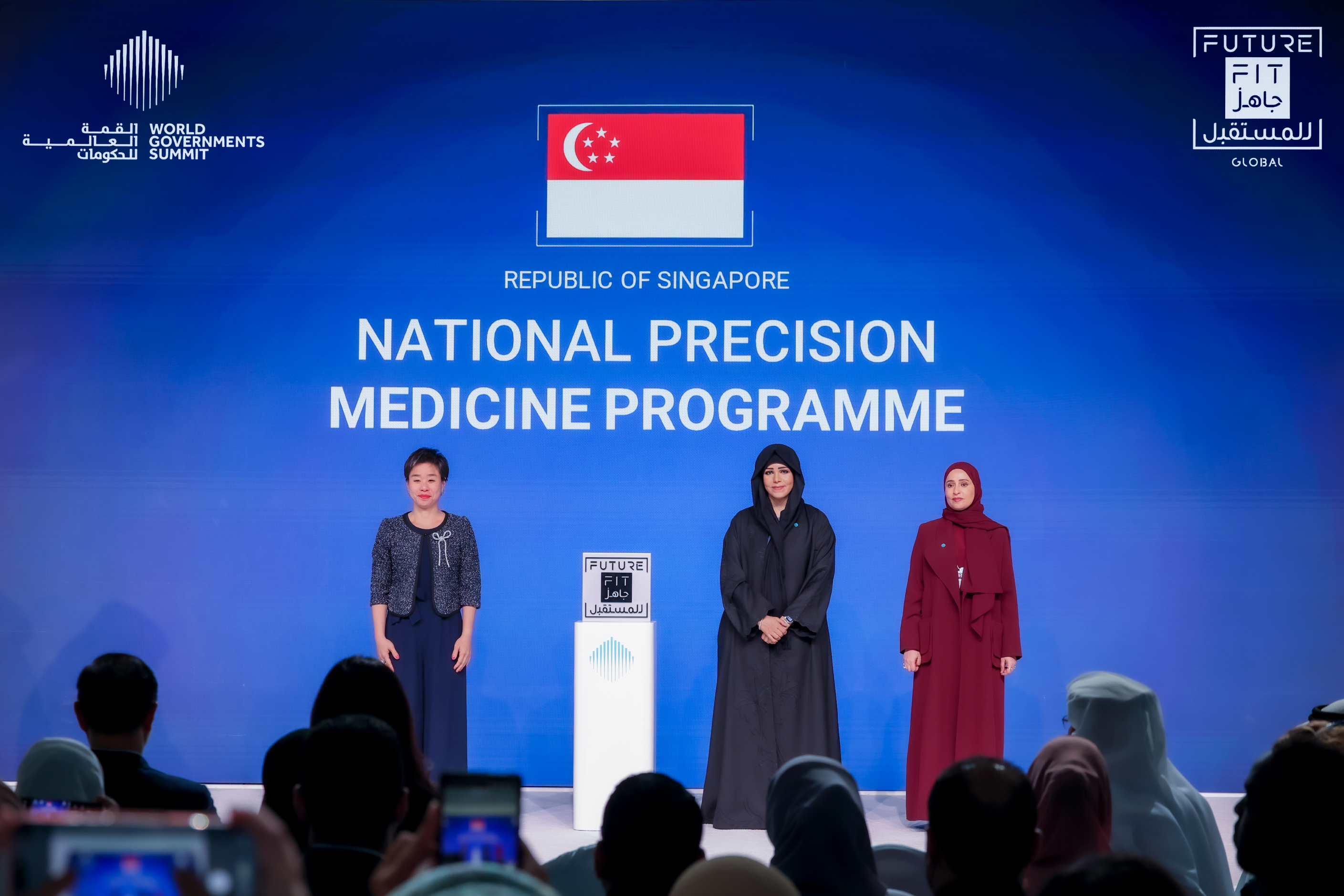
Singapore’s National Precision Medicine Programme has won the 2026 Global Future Fit Seal Award for setting the standard in data-driven healthcare.
Advances in genomics, data science and artificial intelligence are redefining what is possible, handing us the keys to a future where entire populations can benefit from more targeted treatments and tailored disease prevention strategies. Singapore is leading the change from promise to practice, orchestrating diverse stakeholders and navigating complex health systems to create positive outcomes for citizens.
The way forward is through systems level integration and a long-term vision that can be implemented responsibly and at scale. These are Singapore’s lessons from the country’s ongoing National Precision Medicine (NPM) programme, which has recently been awarded the Global Future Fit Seal Award at the World Governments Summit held on 3–5 February 2026 in Dubai, United Arab Emirates.
The NPM programme was selected from over 1,500 nominations as an outstanding example of a government initiative that is building capacity to meet future challenges. The selection process involved a rigorous evaluation against a list of criteria including future orientation, proven outcomes, new models and impact. Two other countries were also conferred the award, namely the Republic of Albania for Diella, an AI-powered minister supporting decision making across government processes, and the Republic of Korea for the automation of Busan Port.
Celebrating Singapore’s long-term vision for healthcare
At its core, precision health is about predicting risk and intervening early to prevent disease, all while accounting for the factors that make each individual unique, from their genetics to their environment and lifestyle. Implementing precision health at a national scale, however, requires more than just scientific curiosity; it requires the willingness of the entire ecosystem to work together collaboratively, systematically and transparently.
For Singapore, the journey to becoming “future fit” has been a disciplined, three-phase journey. Phase I focused on building foundational capabilities: establishing governance frameworks, assembling a baseline multi-ancestry Asian reference genome and developing local expertise in genomics and bioinformatics. Phase II expanded this work, deepening clinical insights and strengthening links with healthcare institutions, and establishing a population cohort of 100,000 consented participants capturing Singapore’s diverse Asian population base.
Now into the most ambitious stage, Phase III aims to enrol patients with medical conditions to inform future care. The goal is to enrol 10% of Singapore’s resident population, moving precision health firmly out of the realm of possibility and into practice. This ability to scale from pilot studies to population-level utility distinguishes Singapore’s approach, earning it the attention of the Government Development and the Future Office of the United Arab Emirates. In particular, the NPM programme was recognised for the impactful outcomes already achieved in Phase I and II, as well as in anticipation of even greater impact in Phase III.
“Singapore’s National Precision Medicine programme is distinctive for its full-stack approach, integrating research, innovation and enterprise within a coordinated national effort. This model enables discoveries to be translated more systematically into clinical and societal impact. We are grateful to the organisers of the Global Future Fit Seal Award for recognising the strength and rigour of our research, and for highlighting the importance of long-term, future-ready investments in healthcare,” says Dr Seow Shih Wee, Senior Director of Corporate Services at Precision Health Research Singapore (PRECISE).
From global validation to citizen outcomes
While international recognition validates Singapore’s approach to precision medicine, the ultimate measure of success lies closer to home: better health outcomes for Singaporeans and a healthcare system that remains sustainable in the face of demographic change. By enabling earlier risk detection, more targeted prevention and more effective treatments, precision health supports a shift from reactive care to proactive health management, helping to improve quality of life while making more efficient use of healthcare resources.
In positioning precision health as a national platform rather than a niche programme, Singapore is doing more than adopting emerging technologies. It is demonstrating how careful planning, system-wide integration and long-term investment can translate scientific advances into public value across the population. In doing so, Singapore is not only preparing its own healthcare system for the future, but also showing what is possible when small countries are guided by a clear strategy, strong governance and a focus on citizens, offering a model that others may look to as they chart their own path forward.
Media Contact:
Charlene Tan
Manager, Corporate Communications
Consortium for Clinical Research and Innovation, Singapore
charlene.tan@cris.sg
Trixie Teo
Assistant Manager, Corporate Communications
Consortium for Clinical Research and Innovation, Singapore
trixie.teo@cris.sg