How Host and Microbial Genomics Both Help Us Navigate Mental Health
26 October 2026
Topics
Mental Health
Microbiome
If understanding human genomics gives us a map of the mental health landscape, microbial genomics is like a compass, pointing the way towards health or disease.
To navigate a territory as vast and volatile as the human mind, we not only need a good map but also a compass to point us in the right direction. In this analogy, studying human genomics gives us a lay of the land, mapping out our inherited predispositions and the genetic landmarks that shape our bodies and behaviours. Microbial genomics, on the other hand, acts as a compass, dynamically responding to changes in the environment, diet, and stress, revealing the directional influences steering us towards health or disease.
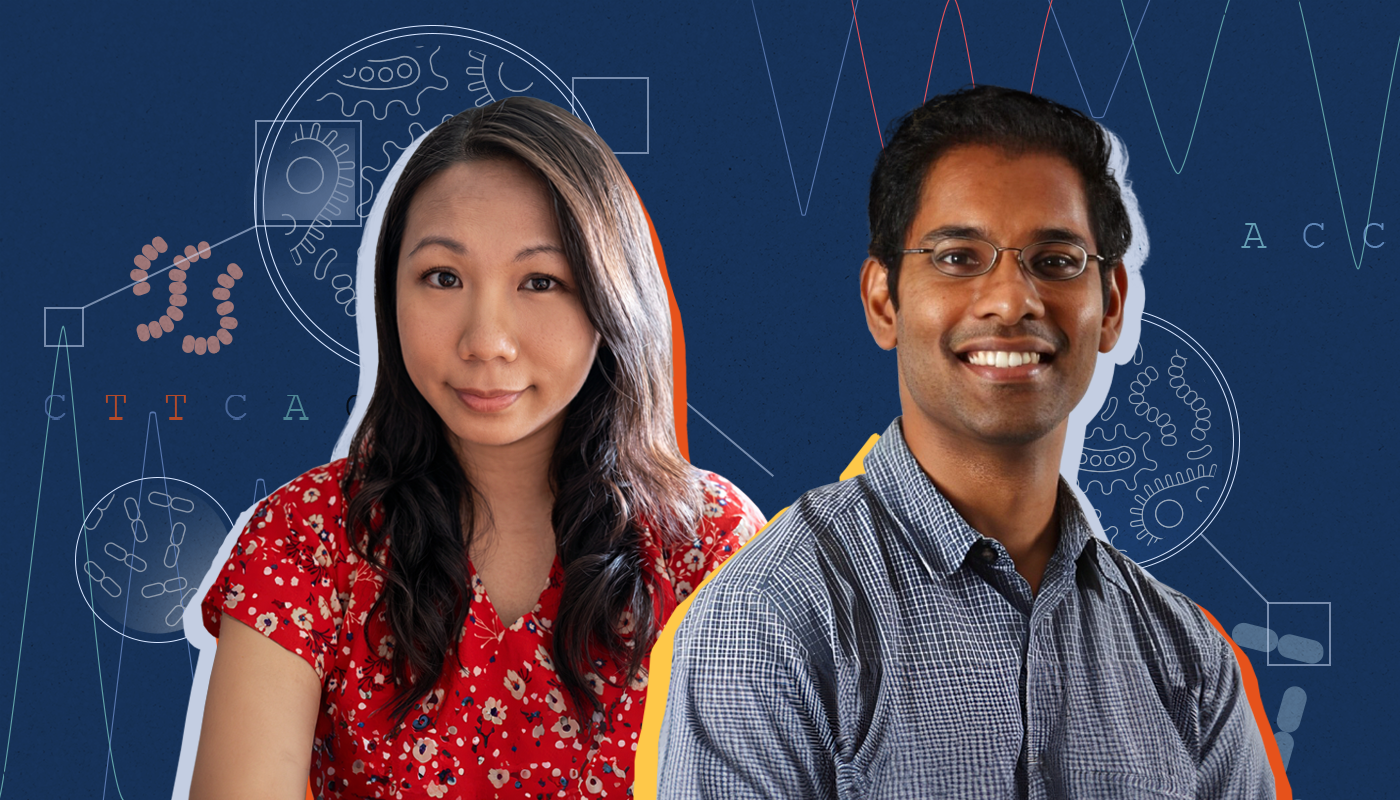
The Gut-Linked Outcomes in Wellbeing (GLOW) project thus combines both human and microbial genomics, powerfully integrating them to chart a path toward mental health. In this fouth article of a series on microbiomes and mental health, Assistant Professor Marie Loh of the Lee Kong Chian School of Medicine at Nanyang Technological University and Associate Professor Niranjan Nagarajan at the National University of Singapore and Genome Institute of Singapore, Agency for Science, Technology and Research, explain how their complementary lines of research can powerfully come together to better understand the role of microbes in mental health.
Reading the multi-omic map
When it comes to human biology, sequencing a person’s DNA gives us a relatively stable map, outlining his or her genetic potential and predispositions. While a person’s DNA typically does not change over the course of their lifetime except for spontaneous mutations, DNA alone does not tell the whole story. In the cell, the reality is much more dynamic. Individual genes can be switched on or off with chemical modifications like DNA methylation, which in turn affects the transcription of DNA into RNA and the translation of RNA into protein, explains Loh.
“Transcriptomics is like checking which instructions a cell is reading at a given moment, it tells us what the cell plans to do by looking at which genes are active,” she says. “Metabolomics, on the other hand, tells us what has happened and is happening by looking at the small molecules present in the cell, be they sugars, fats or amino acids. This gives us a snapshot of the actual activity inside the cell.”
At GLOW, the ambition is to combine these different approaches—genomics, transcriptomics and metabolomics—to build up a comprehensive understanding of the human host. “This is what we call integrative multi-omics. By collecting all the different layers together, we get a more holistic view of what’s happening in the body,” Loh adds.
Minding the microbiome
While Loh and her team focus on the human side of the equation, Nagarajan takes a computational approach to deciphering the gut microbiome. Unlike human DNA, which comes from a single “book” of instructions, the microbiome is more like a massive library of thousands of different bacterial “books”, some known and many unknown, all mixed together. “Assembling the microbiome’s genome is like taking books that have been shredded into pieces and trying to make sense of that,” he says. “That’s where computational genomics comes in, using advanced statistics and algorithms to piece things back together.”
For years, “short-read” sequencing was the state of the art, providing high accuracy for short snippets of DNA that then needed to be lined up into the full sequence by computer software. In a stool sample containing billions of bacteria with overlapping DNA fragments, this was no easy feat, and only provided a low resolution view of the full diversity of gut bacteria.
More recently, “long-read” sequencing has revolutionised the field by capturing much longer, continuous stretches of DNA, making it possible to assemble complete microbial genomes and precisely identify distinct bacterial populations shaping mental health. “I think we can galvanise the entire scientific community worldwide to take datasets like this and figure out what is the best way to do this kind of analysis,” Nagarajan enthuses.
The way forward
Though already insightful on their own, the power of the GLOW study lies in the integration of both the human and the microbial layers. Citing the analogy of the blind men and the elephant, Nagarajan says that while one researcher might describe the trunk of the “mental health elephant” with human genomics and another might see the ears by looking at the microbiome, neither understands the whole animal in isolation.
“We hope that by layering the information from different disciplines can help us have more accurate and actionable predictions, for mental health outcomes in the case of GLOW, but also more generally,” adds Loh. “I would consider this project a success if we can eventually benefit patients. That benefit can come in many forms: better patient stratification, better selection of treatments or novel therapeutics. We might even have microbial interventions, that’s the hope.”
Focusing on mental health at the population level, Nagarajan is looking forward to possible low-cost, early interventions, backed by robust evidence. “If we had a solid mechanistic understanding of how interventions like diet, mindfulness and exercise work, it would transform healthcare. Getting to a more preventive rather than reactive approach; that’s the holy grail,” he says.
Though the journey to proactive mental health at the population level is likely to be filled with peaks and valleys, having a reliable map and a responsive compass will go a long way to charting a clear path forward.