Nature Genetics: Translating genomic data into healthcare practice with the Singapore National Precision Medicine Programme
Topics
Asian Health
Disease Areas
Genomics
Innovation
Precision Medicine
4 August 2026
Singapore's National Precision Medicine programme charts a decade of progress in Nature Genetics
PRECISE and collaborators have published a new article in Nature Genetics tracing the National Precision Medicine (NPM) programme's development over the past decade, capturing Phase II achievements and the roadmap towards Phase III.
This reflects the collective effort of multidisciplinary teams across Singapore and internationally, made possible by the sustained support of NRF and NMRC — and most importantly, the trust of more than 100,000 Singaporeans whose participation underpins this work.
Read the full article: Translating genomic data into healthcare practice with the Singapore National Precision Medicine programme, Nature Genetics (2026). DOI: 10.1038/s41588-026-02687-8
To make the research accessible to everyone, the following summary was prepared by Chew Kim Soon, a member of our Patient and Public Involvement (PPI) community.
Translating genomic data into healthcare practice with the Singapore National Precision Medicine Programme
The big idea
Singapore has spent almost a decade building a national programme, called the National Precision Medicine (NPM) programme, to study how genomic information could improve disease prevention, diagnosis and treatment when linked securely with genomic data. The goal is to shift healthcare from reacting to disease when it appears, toward predicting and preventing it early. The programme is also a demonstration of how a small country like Singapore can still make meaningful global contributions to precision medicine.
Why genes matter for healthcare
Small differences in DNA affect how likely someone is to develop certain conditions (e.g. heart disease, diabetes or certain cancers) and how their body responds to medicines. Most of the big genetic studies to date were done on Western (mainly European) populations, hence their findings don't always apply well to Asian patients. The same gene variant can carry different risks or be missed entirely, in Chinese, Malay or Indian ancestry groups. Singapore's multi-ancestry population makes it a valuable and compact setting for closing this gap.
Three phases, growing in scale and ambition
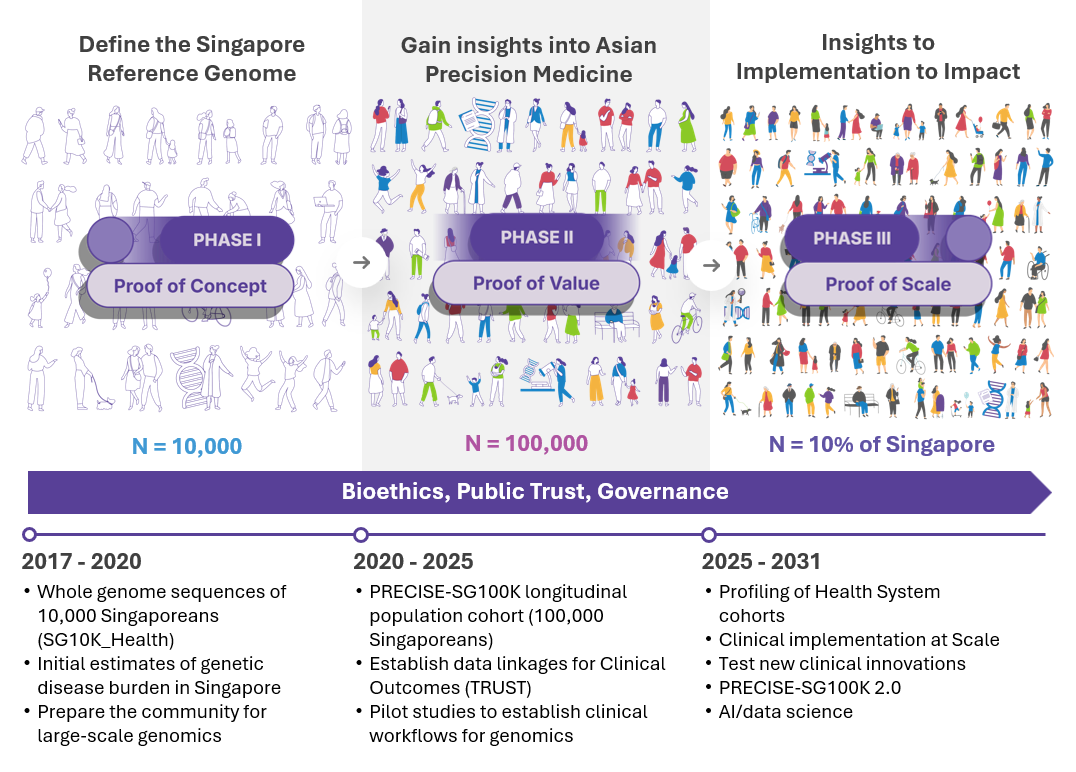
The programme was designed from the outset to be rolled out in stages, with each phase building on the evidence gathered in the last.
Phase I (2017–2021): Sequenced 10,000 Singaporeans to build a reference map of local genetic variation, i.e a 'proof of concept'.
Phase II (2022–2025): Grew the cohort to over 100,000 people (also referred to as the PRECISE-SG100K study), linked their genomes to real health records, and ran pilot clinics using genetic testing, which brings us to a 'proof of value'.
Phase III (2025–2031): Currently underway, it aims to sequence 10% of the entire population (~450,000 people) and weave genome data into everyday hospital care, finally leading up to a 'proof of scale'.
From research finding to hospital practice: the cholesterol example
The clearest success story so far involves familial hypercholesterolemia (FH), an inherited condition causing dangerously high cholesterol and early heart disease.
Roughly 1 in 140 Singaporeans carries an FH-causing gene variant. Using evidence from its pilot studies, Singapore's Ministry of Health decided to roll out national genetic screening for FH in 2025, augmenting the country's existing cholesterol-screening infrastructure.
Rather than specialist doctors, it is genetic counsellors who now lead most patient testing and family screening (also known as cascade testing), where the programme is also affordable enough to run nationwide.
Significantly, about 10% of people found to carry the FH gene had normal-looking cholesterol results and would have otherwise been missed by regular blood tests alone.
Other genetic conditions being tackled
Alport syndrome
A hereditary kidney disease, whereby early testing could potentially delay kidney failure by ~20 years for the 1 in 150 Singaporeans who carry it.Hereditary breast and ovarian cancer
Improving access to genetic testing for the 1 in 150 people at risk.More targeted drug prescription (pharmacogenomics)
Using DNA to flag who is likely to have a bad reaction to common medicines before they're prescribed.Breast cancer screening
Testing whether personal genetic risk scores (and not just age) should decide when an individual starts mammograms.
Growing a broader genomics ecosystem
Beyond patient care, a genetic carrier-screening test has also been developed locally and licensed to a local startup – it covers over 20 diseases commonly found in Asians which is omitted in Western test kits. A consortium of five global pharmaceutical companies also now collaborates with Singapore researchers to carry out health and biomedical research using NPM data sets. Additionally, Singapore has partnered global sequencing companies such as Illumina to strengthen DNA sequencing infrastructure, while creating local jobs and expertise along the way.
A model for smaller countries
More than half of the world's nations have populations under 10 million. Singapore's experience suggests such countries — while unable to match the sheer numbers of larger countries— can still contribute meaningfully to global genetic research. This is partly because their smaller, unified healthcare systems make it easier to test and roll out new practices nationwide. Notably, many small nations (Finland, Qatar, Singapore) have distinctive populations which are capable of revealing findings that larger, more mixed populations cannot.
Looking ahead
As part of NPM Phase III, Singapore aims to recruit around 450,000 participants by 2031 to study how genomic information could be used more widely within the healthcare system. This will generate evidence to inform the feasibility of ‘sequenced once and consulted repeatedly’ (also known as SOAR) across their lifetime, which includes newborn screening through to cancer assessment. The authors frame this as evidence that thoughtful national strategy, not just population size, is what turns genetic science into everyday healthcare impact.