

Shaping Precision Medicine Conversations through Genetic Counselling
When is a genetic test necessary? What is it for? And perhaps most importantly—what do the results mean for you and your family? As Singapore embarks on the gradual roll out of precision medicine approaches in the healthcare system, supported by the PRECISE-SG100K population cohort study, the ability to accurately interpret and communicate genetic results—without causing undue anxiety—has never been more critical. At the frontlines are genetic counsellors, who help play a critical role in helping patients and families understand precision medicine and its applications in healthcare.
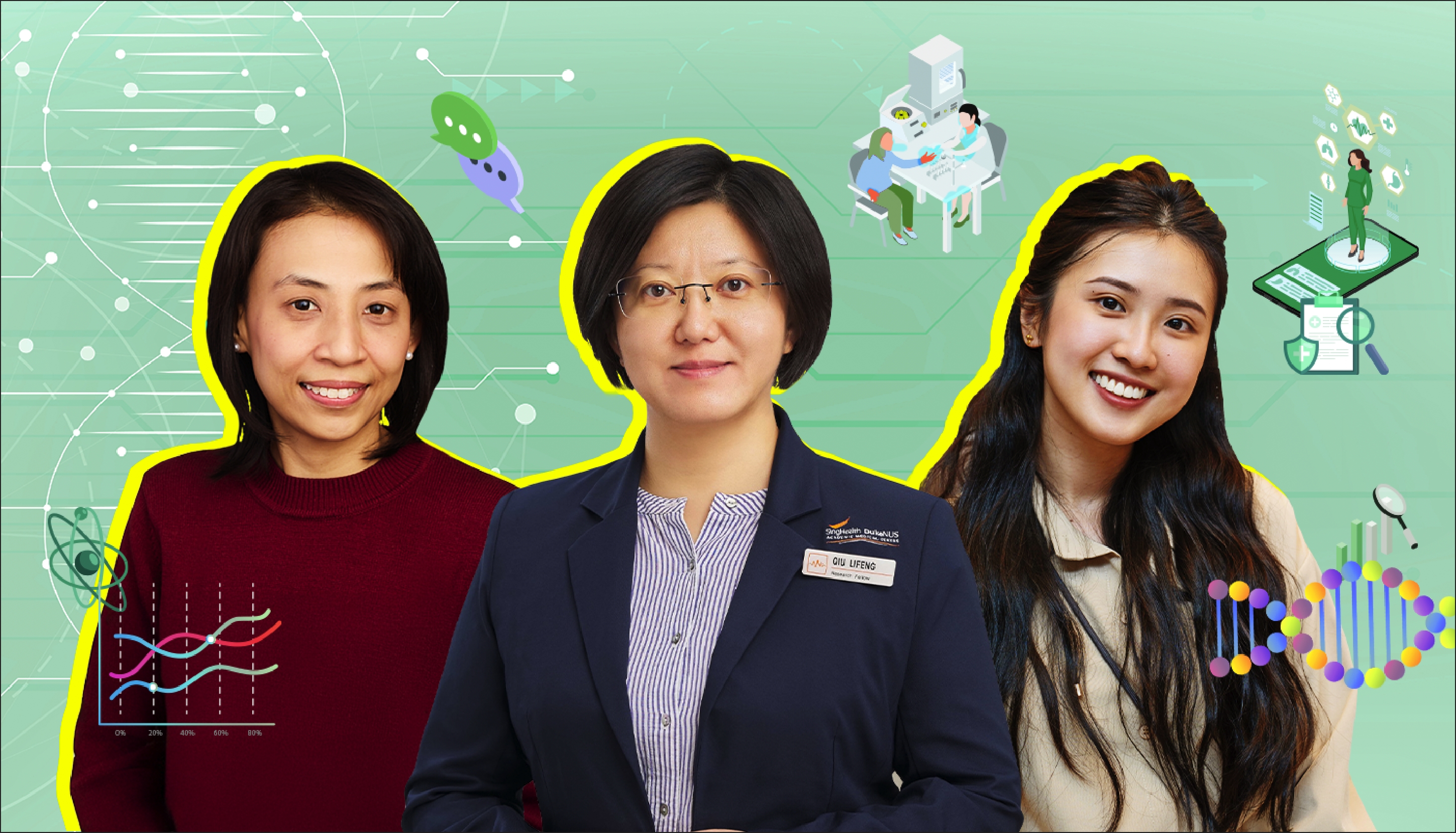
With the aim of deepening understanding of clinical genomics and strengthening genetic counselling capabilities across healthcare domains in Singapore, Precision Health Research, Singapore (PRECISE) partnered SingHealth Duke-NUS Genomic Medicine Centre (SDGMC) on the Executive Certificate Programme in Clinical Genomics. Norhafizah (Fizah) Abdullah, Wu Jianglei (Serene) and Qiu Lifeng share their experiences.
For all three of them, genetic counselling is not new. Through their work at National Cancer Centre Singapore (NCCS) and National Neuroscience Institute (NNI) respectively, they have been exposed to genetic counselling in different capacities.
As an Associate Genetic Counsellor at NCCS, Serene is not only well-versed in the cancer genetics space, but she also has a deep appreciation for the value that a genetic counsellor brings to patients and their families. “Genetic counsellors help individuals and families understand what their genetic test results mean—and the implications of these findings on their health risks or future decisions. But their work doesn’t stop there. Genetic counsellors also support their clients through the psychosocial challenges that may arise from this knowledge,” she said. “To do this work well, professional training is essential for one to have a good understanding of genomics, strong communication skills—and the ability to provide empathetic, client-centred support.”
Laying the Foundation for Further Education
Serene’s passion for helping patients better navigate their genetic information led her to seek advancement through the Executive Certificate Programme in Clinical Genomics.
The course covers a broad overview of genetics across different areas, including paediatrics, neurology and cardiology—presenting an opportunity to strengthen her foundation in genomics beyond the oncology space she was familiar with. Serene said, “I also saw it as good preparation for my Master’s.”. Indeed, while doing her Master’s in Genetic Counselling after completing the programme, Serene was able to better grasp advanced genetics and genomics concepts across various conditions easily.
Fizah, who was also working at NCCS as a Research Coordinator and is currently pursuing a Master of Science in Genetic Counselling at the Icahn School of Medicine at Mount Sinai in the United States (US), is in agreement. Like Serene, working in the cancer genetics space has given her a solid foundation in the clinical genomics domain. But her interest in genomics goes beyond that, she shared. “Having participated in data collection during Singapore’s early efforts in Phase I of the National Precision Medicine programme, I am deeply interested in exploring how we can translate the findings into clinically relevant insights for our population. It just so happened that when the programme came up, I was preparing my genetic counselling Master’s application—so the timing was just perfect. I believe it added value to my academic pursuits in the field.”
Transforming Knowledge into New Possibilities
The Executive Certificate Programme in Clinical Genomics has proven to be enriching for both Fizah and Serene, professionally and personally. While Serene feels better equipped to address patients’ concerns and assess the need for further escalation, Fizah appreciates the chance to hone her communication skills through roleplay exercises with simulated patients, allowing her to further develop her empathy and critical thinking abilities, which are essential for providing informed guidance and personalised care.
For Lifeng, a Postdoctoral Research Fellow at National Neuroscience Institute, her role as a researcher in a hospital puts her at the forefront of medical research and developments. This sparked her curiosity and fascination with the growing global focus on precision medicine, the rapid evolution of genetic testing technologies and the potential of precision medicine therapies in treating diseases. “As a neuroscientist, I am interested in learning about genomics and how it might enhance our understanding of brain diseases and their treatments. One example is frontotemporal dementia (FTD). We now know from data that up to 40% of FTD have a genetic basis. However, most of this data comes from studies in Europe and the US, and it’s unclear whether the same trends hold true for our local population,” Lifeng explained.
“Compared to fields such as paediatrics, neonatology and oncology, genetic counselling for neurological conditions is relatively nascent. But if we can better counsel and educate patients on the importance of genetic testing, it could provide significant opportunities to uncover links between genotypes and disease onset, prognosis, and treatment. I’m glad that this programme equips me with the essential skills to contribute meaningfully in this area.”
Advocating for Precision Medicine
But Lifeng is not limiting the application of her newfound knowledge to just research. She added, “Through the course, I’ve acquired foundational knowledge in genomics that will enable me to conduct future studies spanning neuroscience and genomics domains—with the hope of contributing valuable insights to the treatment of brain diseases.”
Similarly, Fizah hopes to contribute to shaping precision medicine conversations through genetic counselling after completing her Master’s. She said, “The work of a genetic counsellor is meaningful because we have the opportunity to not only impact the health of a population, but also the health of generations to come—through early and preventive interventions.”
Adding on, Serene shared, “But before that, we need to grow the population of genetic counsellors in Singapore. Right now, few people know who genetic counsellors are or what we do. There’s an urgency to raise awareness of the profession and make the career pathway more accessible—because only then can we truly realise our aspirations for precision medicine.”
Building the Foundations through Singapore’s National Precision Medicine programme
As the precision medicine becomes mainstream medicine, the foundations needed for data-driven healthcare is of utmost importance. This includes nurturing a strong pipeline of skilled professionals—like genetic counsellors—who are vital to ensuring that genomic insights are translated responsibly and effectively into clinical care.
By deepening our understanding of the Asian genome and strengthening local capabilities in clinical genomics, precision medicine can eventually be seamlessly integrated into everyday healthcare—transforming not just individual lives, but population health as a whole.